Completed · Free
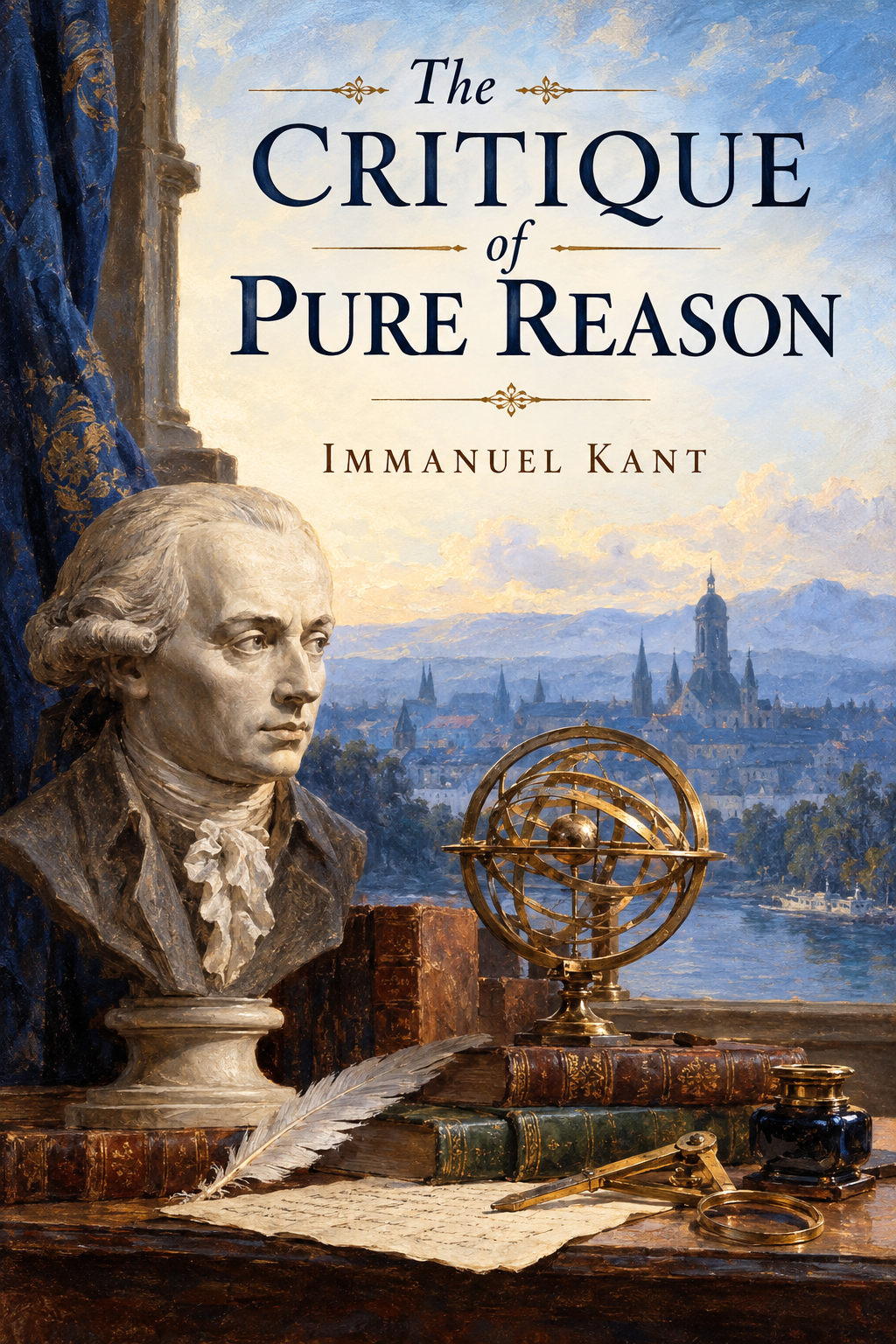
THE CRITIQUE OF PURE REASON
I undertake the examination of reason itself, not in regard to what it learns from experience, but in regard to those cognitions which it claims to possess independently of all experience. The question is therefore whether pure reason is capable of extending knowledge beyond the limits of possible experience, and, if so, by what right it makes such claims. To this end, I investigate the conditions under which objects can be given to us in sensibility, the forms through which the understanding thinks them, and the principles by which experience itself becomes possible. Space and time, the categories of the understanding, the unity of self-consciousness, and the laws governing appearances must all be examined before metaphysics can claim the certainty of a science. Yet reason inevitably seeks what no possible experience can provide: the soul as a complete substance, the world as a totality, and a highest being as the ultimate ground of all things. When reason attempts to transform these ideas into objects of knowledge, it falls into illusion, contradiction, and antinomy. The task of critique is therefore not to destroy metaphysics, but to determine its proper boundaries. The Critique of Pure Reason is thus an inquiry into the powers and limits of human cognition: what we can know, what we cannot know, and why reason is nevertheless compelled to ask questions that experience can never answer. Only after reason has judged its own capacity can a secure foundation for metaphysics be established.
- Language
- EN
- Genres
- philosophy
- Series
- The Kant Critiques
- Book number
- 1
- Listing updated
Make reading more personal
Read the available chapters as a guest, or sign in to read the full book for free. A free reader account lets you build your personal library, save your reading position and share feedback with authors. Book purchases and optional paid features are separate.