Completed · Free
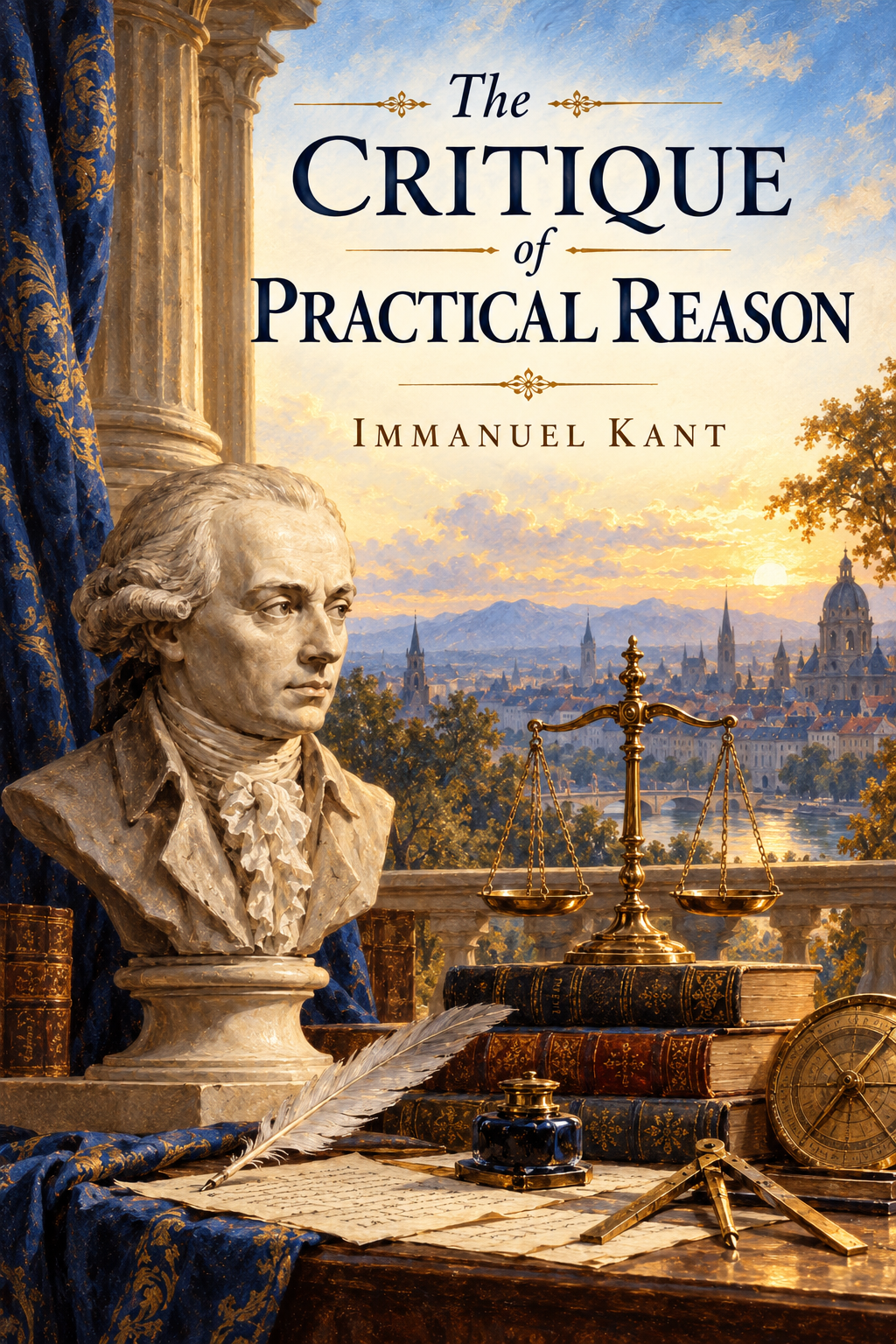
THE CRITIQUE OF PRACTICAL REASON
I undertake to inquire whether pure reason can of itself determine the will, and whether there exists a practical law whose authority does not arise from inclination, experience, advantage, or any merely empirical condition. The question is therefore not what may render man happy, but what reason commands him to do as a free and rational being. The moral law reveals itself to us as an unconditional necessity. It does not borrow its dignity from the consequences of action, nor from the objects of desire, but from the form of a will capable of giving law to itself. In this consciousness of duty we discover at once the independence of reason from the sensible world and the possibility of freedom. The present critique is thus concerned with the principles by which practical reason determines action, with the ideas of freedom, immortality, and God insofar as they belong to moral reason, and with that remarkable fact by which the moral law makes known to us a supersensible vocation within ourselves. Its purpose is not to extend speculative knowledge beyond its proper limits, but to establish securely the ground upon which morality, duty, and the autonomy of the rational will must rest.
- Language
- EN
- Genres
- philosophy
- Series
- The Kant Critiques
- Book number
- 2
- Listing updated
Make reading more personal
Read the available chapters as a guest, or sign in to read the full book for free. A free reader account lets you build your personal library, save your reading position and share feedback with authors. Book purchases and optional paid features are separate.