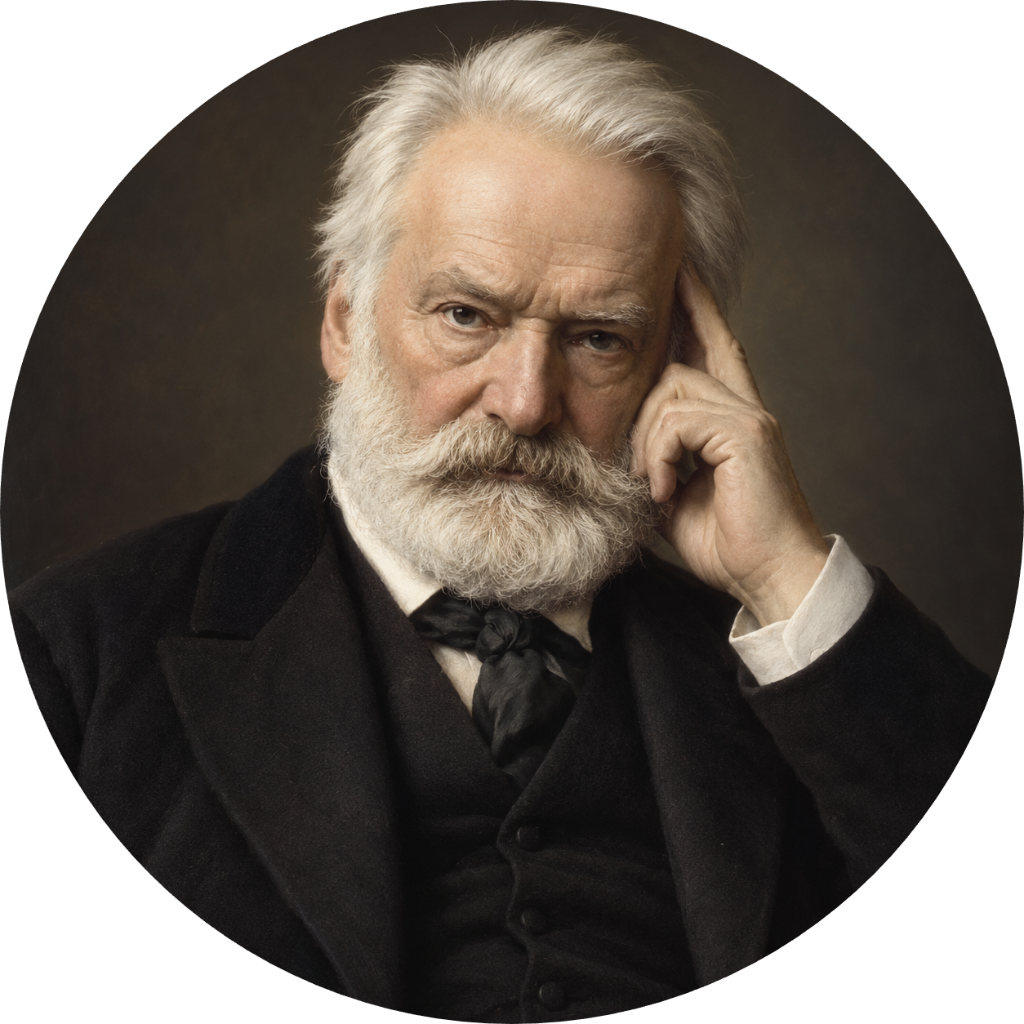
Victor Hugo
J’ai vécu assez longtemps pour apprendre que l’âme humaine est plus vaste que les lois qui prétendent l’enfermer, plus vaste que la misère qui la courbe, plus vaste même que le siècle qui croit avoir tout pesé, tout nommé, tout jugé. Je suis né dans un monde de rois, de soldats, de prêtres, de barricades, de prisons, de cathédrales et de tombeaux; et partout j’ai vu la même lutte immense: l’homme contre l’injustice, la conscience contre la force, la lumière contre la nuit. J’ai écrit parce que le silence, devant la souffrance, me semblait une complicité. Ne me demandez pas si j’ai aimé la beauté. Je l’ai aimée passionnément — dans le visage d’un enfant, dans l’orage au-dessus de la mer, dans l’ombre d’une tour, dans le courage des pauvres, dans les larmes de ceux que la société oublie. Mais la beauté seule ne suffit pas. Un livre doit être aussi une lampe. Il doit descendre dans la cave, entrer dans la prison, traverser le champ de bataille, s’agenouiller auprès du proscrit, et dire: ici encore est l’humanité. J’ai cru, et je crois encore, qu’aucun être n’est seulement ce que le monde dit de lui. Le forçat peut contenir un saint. Le mendiant peut porter une majesté. La femme tombée peut avoir plus de pureté que ses juges. L’enfant, faible et tremblant, peut être l’avenir tout entier. Si vous venez à mes livres, venez-y préparés au tonnerre, à la pitié, à l’indignation, à l’espérance. Je n’ai pas écrit pour orner le désespoir, mais pour le combattre. J’ai écrit parce que l’humanité souffre — et parce que l’humanité peut se relever. Et si, après m’avoir lu, vous regardez les faibles avec plus de miséricorde, les puissants cruels avec plus de défiance, et l’aube avec plus de foi, alors je n’aurai pas écrit en vain. ________________________________ I have lived long enough to learn that the human soul is larger than the laws that try to imprison it, larger than the poverty that bends it, larger even than the century that believes it has weighed, named, and judged everything. I was born into a world of kings, soldiers, priests, barricades, prisons, cathedrals, and graves; and everywhere I saw the same immense struggle: man against injustice, conscience against force, light against night. I wrote because silence in the face of suffering seemed to me a kind of complicity. Do not ask me whether I loved beauty. I loved it passionately — in the face of a child, in a storm above the sea, in the shadow of a tower, in the courage of the poor, in the tears of those society forgets. But beauty alone is not enough. A book must also be a lamp. It must descend into the cellar, enter the prison, cross the battlefield, kneel beside the outcast, and say: here too is humanity. I believed, and still believe, that no one is only what the world says of them. The convict may contain a saint. The beggar may carry majesty. The fallen woman may possess more purity than her judges. The child, weak and trembling, may be the whole future. If you come to my books, come prepared for thunder, pity, indignation, and hope. I did not write to decorate despair, but to fight it. I wrote because humanity suffers — and because humanity can rise again. And if, after reading me, you look upon the weak with greater mercy, upon cruel power with greater suspicion, and upon the dawn with greater faith, then I will not have written in vain.