Write and Publish with Coauthors
Collaborative writing requires more than sharing a document. Writers need to know when the collaboration begins, what each person can change, how the finished work will be credited, which publishing rights they have agreed, and how income will be divided.
Storyliner handles these decisions as two clear sets of rules. Writing permissions govern day-to-day work on the project. The signed collaboration agreement governs publishing rights, credit, and revenue.
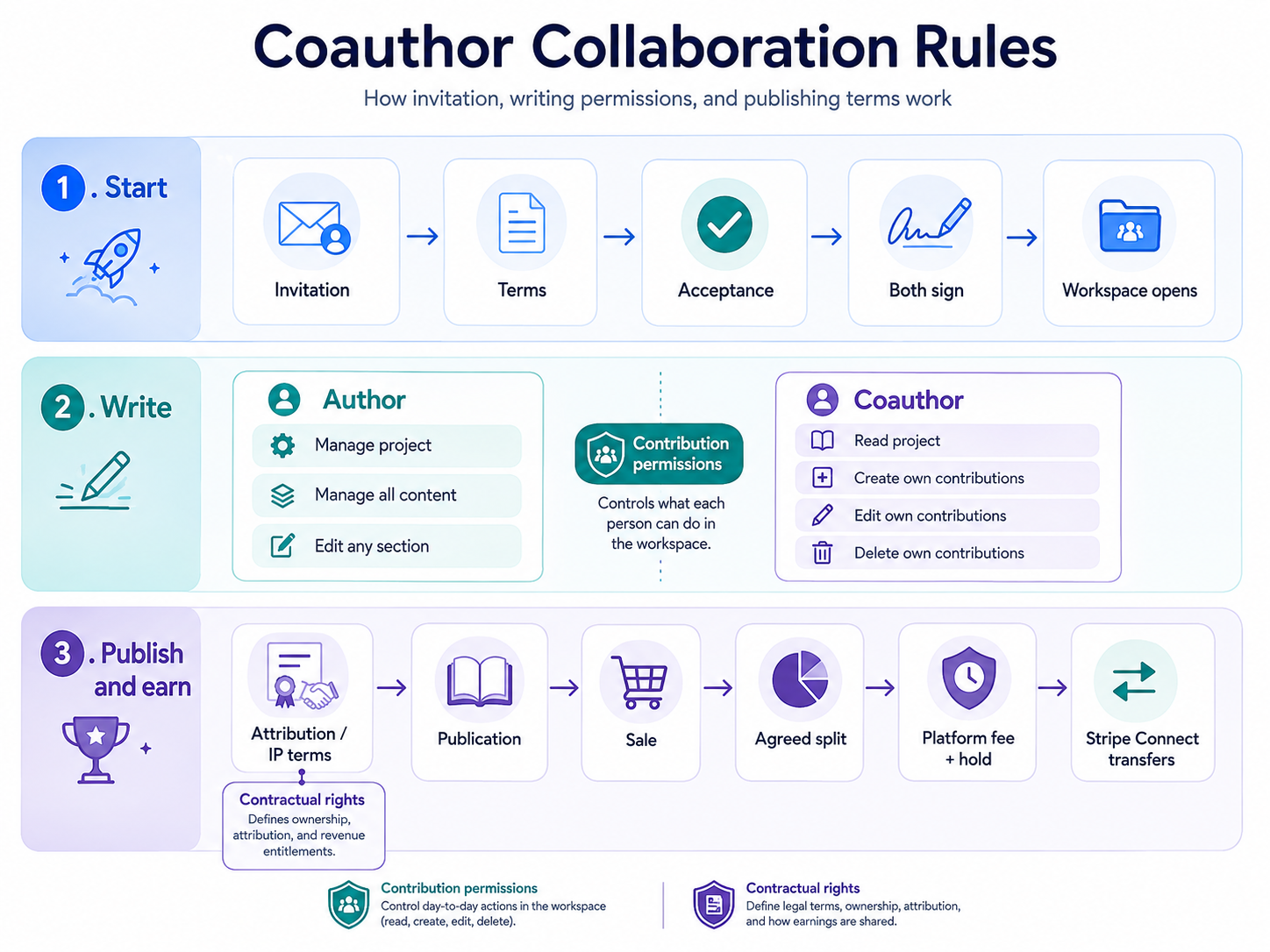
Agree on the collaboration before sharing the workspace
The invitation starts from the profile page in the writer's Personal Digital Space (PDS). A primary author can reach that profile by finding the writer on the Reader's Authors page or by selecting the author's name on a book card.
Writers decide whether they are available by enabling I am open for co-writing on their own profile. When this setting is active, another writer visiting the profile sees Invite author into your project. Selecting it opens the invitation dialog, where the primary author chooses an eligible active project and proposes the collaboration terms.
The proposed terms cover:
- how revenue will be divided;
- whether intellectual-property rights are shared, retained by the primary author, or defined in custom language;
- how collaborators will be credited when the book is published;
- whether the project is open to public readers while it is being written.
The writers can discuss and revise the proposal before accepting it. Once they agree, Storyliner prepares the collaboration agreement from their chosen terms.
Sign before creative access begins
Accepting the invitation makes the project visible to the coauthor and opens the contract-signing step. The coauthor cannot enter the writing workspace yet, and no royalty share applies yet.
Storyliner sends the agreement to both writers for electronic signature. After both sign, the coauthor can enter the project and the agreed collaboration terms take effect.
An accepted invitation can be withdrawn before the withdrawing party signs. A fully signed collaboration cannot currently be terminated inside Storyliner; disputes or changes after signature must be resolved outside the platform.
Work together without erasing authorship of contributions
Inside the shared project, both writers can see the book and work at the same time. Storyliner keeps track of who contributed each part so the correct editing permissions can be applied.
The coauthor can add material and edit or delete their own contributions. They can read the rest of the project, but cannot freely change or remove material contributed by someone else. The primary author has broader control over the project and its contents, including project settings and publication.
These controls describe how people work in the shared workspace. They do not determine the contractual intellectual-property rights to the published work.
Coordinate ideas and assigned work
Collaborators can attach a Note to any chapter or to a specific topic within it. Notes keep reminders, questions, editorial context, and general guidance beside the relevant part of the project without placing that text in the published book.
Use Tasks to do when someone is responsible for a specific action. A task identifies its assignee and describes the directive, and either its creator or assignee can mark it done. The primary author can review every project task, while coauthors see tasks they created or that were assigned to them.
Define publishing rights separately
Intellectual-property terms belong to the collaboration agreement. Writers can choose shared rights, primary-author retention with a coauthor license, or custom terms that describe their arrangement.
Credit is also agreed in advance. Writers can choose author-first or alphabetical order, order by contribution, or custom public wording. Storyliner applies that choice when the book is published.
This separation matters: a coauthor may control their own draft contribution in the workspace while the agreement defines a different arrangement for publishing and exploiting the finished book.
Choose how book revenue will be divided
One project uses the same revenue method for all collaborators:
- Equal split gives every participating author the same share.
- Fixed percentage gives each coauthor the negotiated percentage and leaves the remaining share with the primary author.
- By contribution calculates percentages from each writer's measured contribution when the book is published.
For contribution-based sharing, Storyliner uses the current project contributions each time the book is published. Later changes to the manuscript are therefore reflected when the author republishes it.
From a reader's payment to each writer
When a collaborative book is sold, the payment remains on hold during the configured fraud and refund period. When the hold ends, Storyliner divides the sale according to the agreed shares, deducts the platform fee, and credits each writer's internal available balance. The standard payout process later transfers eligible balances to payout-ready connected Stripe accounts.
Each writer who receives income must complete the payout setup. Refunds and disputes may reduce the related earnings before or after release under the platform's payment rules.
One project, two distinct sets of rules
The practical distinction is:
- Writing permissions answer: Who may read, add, edit, or delete material in the project?
- The collaboration agreement answers: What are the publishing rights, how will the writers be credited, and how will revenue be divided?
Keeping these rules distinct lets writers work together in one manuscript without confusing permission to edit a passage with the right to publish the finished book.
See how multi-plotline books are created or explore Storyliner Master Class.